> For the complete documentation index, see [llms.txt](https://www.designreference.xyz/llms.txt). Markdown versions of documentation pages are available by appending `.md` to page URLs; this page is available as [Markdown](https://www.designreference.xyz/leadership/process/design-thinking-dt.md).
# Design Thinking (DT)
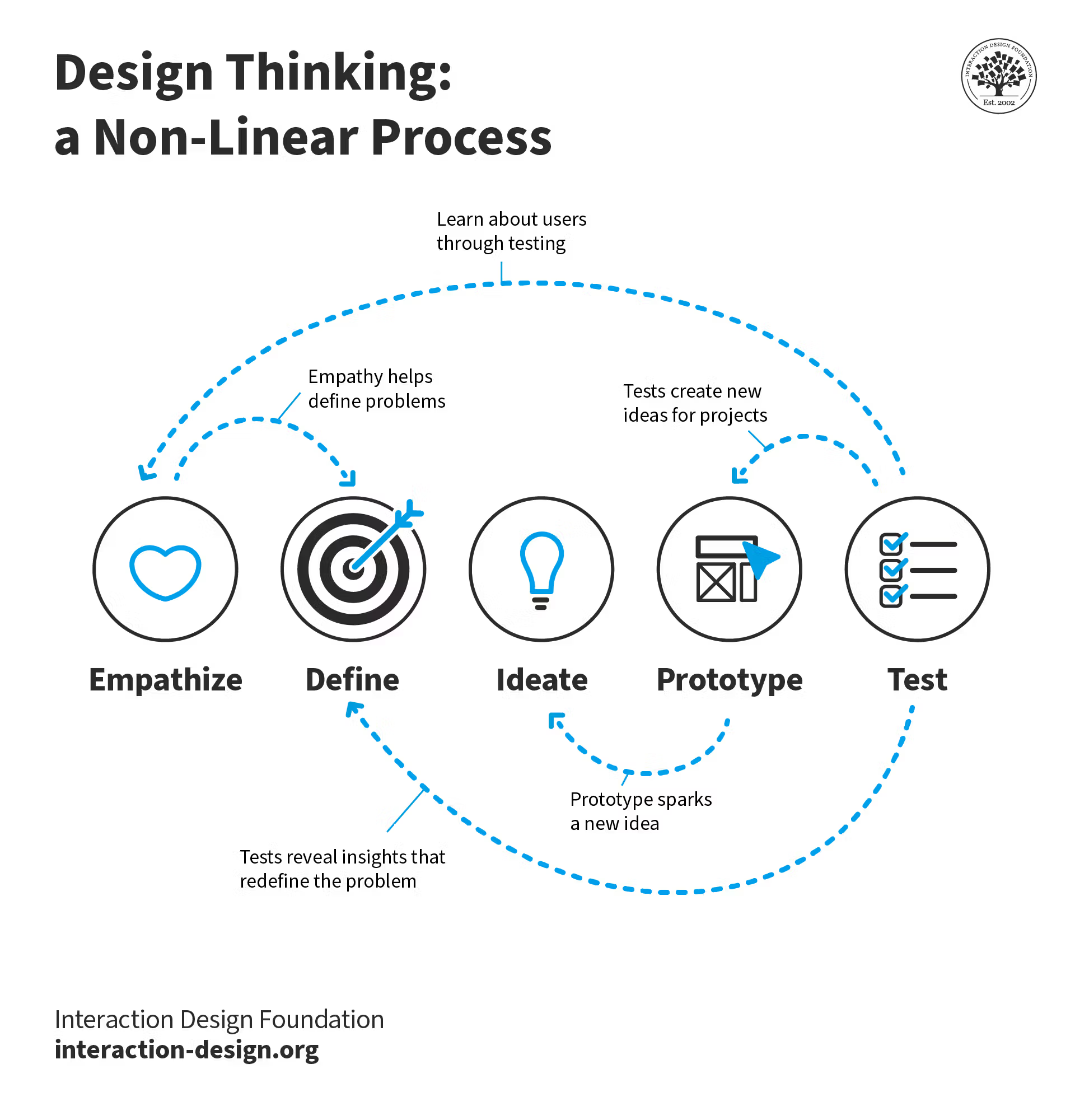
Also widely known as Human-Cantered Design, Design thinking is a non-linear, iterative process that teams use to understand users, challenge assumptions, redefine problems and create innovative solutions to prototype and test. It is most useful to tackle ill-defined or unknown problems and involves five phases: Empathise, Define, Ideate, Prototype and Test.
Design thinking provides a holistic framework for addressing complex problems by putting the user at the center of the design process. It complements and enhances other design approaches by fostering innovation, empathy, and a focus on human needs.
#### Design Thinking: A Human-Cantered Approach
Design thinking is a creative problem-solving methodology cantered around understanding user needs and developing innovative solutions. It emphasizes empathy, experimentation, and iteration. The process is typically broken down into five phases:
1. **Empathise**\
Immerse yourself in the user's world to gain deep insights into their needs, motivations, and pain points.
2. **Define**\
Synthesise your research findings to identify the core problem you want to solve.
3. **Ideate**\
Generate a wide range of creative solutions to the problem, encouraging out-of-the-box thinking.
4. **Prototype**\
Create tangible representations of your ideas, whether it's sketches, wireframes, or physical prototypes.
5. **Test**\
Gather feedback on your prototypes from users to refine and improve your solutions.
#### Design Thinking vs. Other Design Approaches
Design thinking differs from other approaches in a few key ways:
* Focus on Human Needs: Design thinking places a strong emphasis on understanding and addressing user needs, whereas other approaches might focus more on technical feasibility or business requirements.
* Iterative Process: Design thinking is highly iterative, with a constant cycle of learning, creating, and testing. This allows for flexibility and adaptability throughout the design process.
* Creative Mindset: Design thinking encourages a creative and open-minded approach to problem-solving, valuing divergent thinking and unconventional ideas.
* Collaboration: Design thinking often involves collaboration between diverse teams, including designers, engineers, marketers, and even users themselves.
#### Comparing Design Thinking to Lean UX and Agile Design/UX
* Lean UX: Focuses on building minimum viable products (MVPs) to quickly test assumptions and gather user feedback. Design thinking can be integrated into Lean UX to enhance the user-cantered aspect of the process.
* Agile Design/UX: Emphasises iterative development and collaboration between designers and developers. Design thinking can be used to inform the user-cantered design principles within Agile frameworks.
#### Further Reading
{% embed url="" %}
{% embed url="" %}
{% embed url="" %}
{% embed url="" %}
{% embed url="" %}
{% embed url="" %}
#### Further Viewing
{% embed url="" %}
{% embed url="" %}
{% embed url="" %}
{% embed url="" %}
{% embed url="" %}
{% embed url="" %}
{% embed url="" %}
{% embed url="" %}
{% embed url="" %}
{% embed url="" %}
{% embed url="" %}
{% embed url="" %}
{% embed url="" %}
{% embed url="" %}
#### Curated Library
{% embed url="" %}
---
# Agent Instructions
This documentation is published with GitBook. GitBook is the documentation platform designed so that both humans and AI agents can read, navigate, and reason over technical content effectively. Learn more at gitbook.com.
## Querying This Documentation
If you need additional information that is not directly available in this page, you can query the documentation by asking a question.
Perform an HTTP GET request on the following URL with the `ask` and `goal` query parameters:
```
GET https://www.designreference.xyz/leadership/process/design-thinking-dt.md?ask=&goal=
```
`ask` is the immediate question: it should be specific, self-contained, and written in natural language.
`goal` is what the user is ultimately trying to achieve, the reason they need the answer. Sharing it helps GitBook give you a better, more relevant answer. A goal is most helpful when it describes the outcome the user wants rather than restating the question. For example, with `ask=how do I create an API token`, a goal like `automate deployments from our CI pipeline` lets GitBook tailor the answer to that use case.
The response will contain a direct answer to the question and relevant excerpts and sources from the documentation.
Use this mechanism when the answer is not explicitly present in the current page, you need clarification or additional context, or you want to retrieve related documentation sections.