> For the complete documentation index, see [llms.txt](https://www.designreference.xyz/llms.txt). Markdown versions of documentation pages are available by appending `.md` to page URLs; this page is available as [Markdown](https://www.designreference.xyz/cognitive-tools/ux-laws-principles/concepts-and-models/cognitive-bias/the-sunk-cost-fallacy.md).
# The Sunk Cost Fallacy
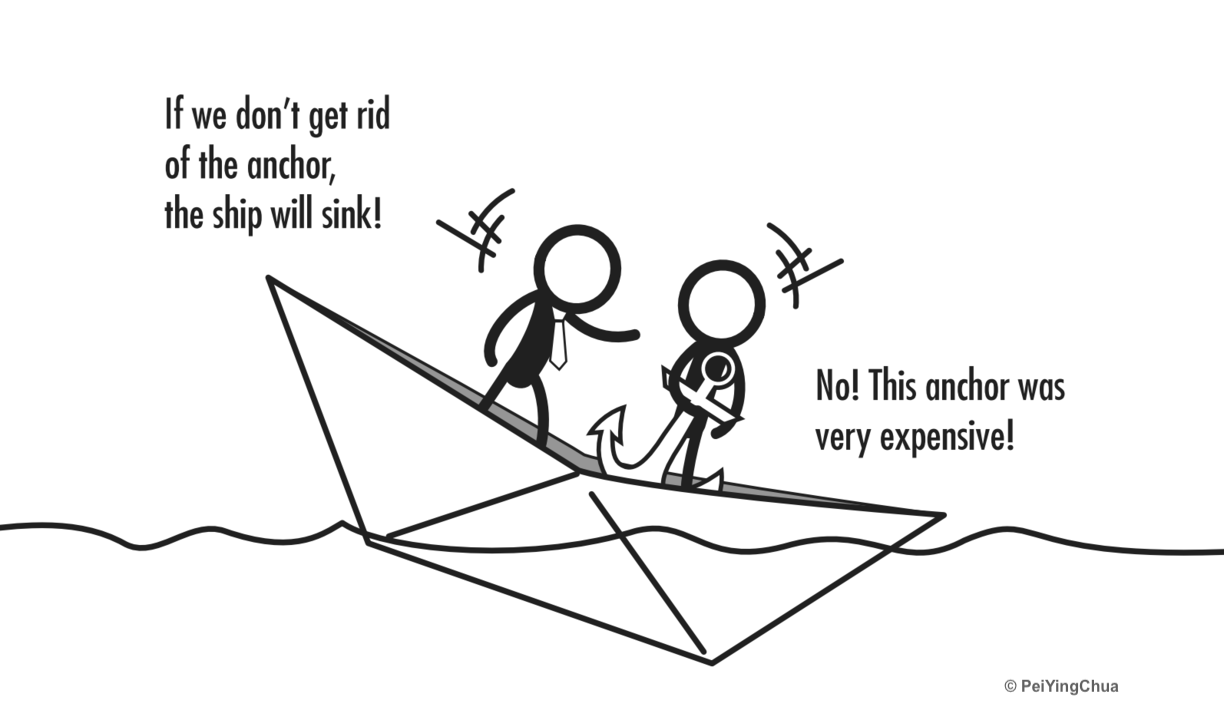
The Sunk Cost Fallacy is a common cognitive bias where people continue to invest in a decision, project, or action due to the amount of time, money, or resources they've already spent on it, despite evidence suggesting that future costs outweigh the benefits. Essentially, people fall into the trap of "throwing good money after bad" because they feel reluctant to abandon what's already been invested. Avoiding the sunk cost fallacy allows people to make decisions more rationally, ensuring resources are directed towards genuinely promising ventures.
#### Sunk Costs Defined
A sunk cost is any past expense or effort that can't be recovered. For example, money spent on a product development project or hours devoted to a task are sunk costs because they’re irretrievable.
#### How the Fallacy Works
Rather than focusing on the present and future value of a decision, people focus on past costs, which clouds their judgement. For example, if a business has already spent a significant amount on a failing project, they might keep funding it, hoping it will eventually turn around, even if the evidence shows it's unlikely to succeed.
#### Why It Happens
The fallacy often stems from psychological factors such as loss aversion (the pain of losing what's already been invested), over-optimism (believing things will improve), or simply commitment to the original goal.
#### Examples
* **Business**\
A company continues to develop a product that shows little market demand because they've already spent heavily on research and development.
* **Personal Life**\
Someone persists in a relationship or career path that makes them unhappy because they've already spent years in it.
#### How to Avoid It
To counter the sunk cost fallacy, it helps to:
* **Focus on current and future value**\
Make decisions based on potential future outcomes, not past investments.
* **Set clear criteria for continuation**\
Define benchmarks to objectively assess if a project or decision is still viable.
* **Seek outside perspectives**\
External advice can provide a more rational view, reducing emotional attachment to past investments.
#### Further Reading
{% embed url="" %}
{% embed url="" %}
{% embed url="" %}
{% embed url="" %}
---
# Agent Instructions
This documentation is published with GitBook. GitBook is the documentation platform designed so that both humans and AI agents can read, navigate, and reason over technical content effectively. Learn more at gitbook.com.
## Querying This Documentation
If you need additional information that is not directly available in this page, you can query the documentation dynamically by asking a question.
Perform an HTTP GET request on the current page URL with the `ask` query parameter, and the optional `goal` query parameter:
```
GET https://www.designreference.xyz/cognitive-tools/ux-laws-principles/concepts-and-models/cognitive-bias/the-sunk-cost-fallacy.md?ask=&goal=
```
`ask` is the immediate question: it should be specific, self-contained, and written in natural language.
`goal` is optional and describes the broader end goal you are ultimately trying to accomplish on behalf of the user. GitBook uses it to tailor the answer towards what is most useful for that goal.
The response will contain a direct answer to the question and relevant excerpts and sources from the documentation.
Use this mechanism when the answer is not explicitly present in the current page, you need clarification or additional context, or you want to retrieve related documentation sections.