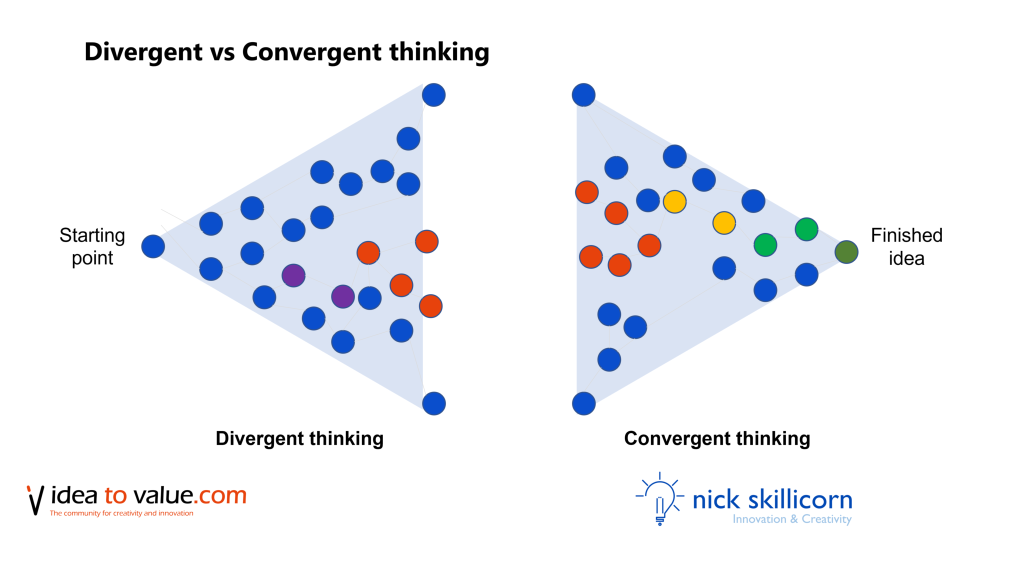
> For the complete documentation index, see [llms.txt](https://www.designreference.xyz/llms.txt). Markdown versions of documentation pages are available by appending `.md` to page URLs; this page is available as [Markdown](https://www.designreference.xyz/cognitive-tools/universal/problem-solving/divergent-and-convergent-thinking.md).
# Divergent & Convergent Thinking
* **Divergent thinking** is the process of generating a wide array of ideas from a single starting point, such as a problem or challenge. It's about thinking outside the box and exploring multiple possibilities.
* **Convergent thinking**, on the other hand, involves evaluating and selecting the most suitable ideas from this pool. It's the process of narrowing down options and focusing on the most promising solutions.
Divergent thinking allows the exploration of a wide range of possibilities, brainstorming without constraint. This helps to generate innovative ideas and break free from conventional thinking. Considering diverse perspectives and experimenting with different approaches, unexpected solutions, that might otherwise be overlooked, can be uncovered.
Once the initial brainstorming phase is complete, convergent thinking refines thoughts. Generated ideas are carefully evaluated, considering factors such as feasibility, cost-effectiveness, and alignment with goals. Through further analysis and prioritisation, options can be narrowed down and the most promising selected to move forward.
#### Further Viewing
{% embed url="" %}
{% embed url="" %}
#### Further Reading
{% embed url="" %}
{% embed url="" %}
{% embed url="" %}
---
# Agent Instructions
This documentation is published with GitBook. GitBook is the documentation platform designed so that both humans and AI agents can read, navigate, and reason over technical content effectively. Learn more at gitbook.com.
## Querying This Documentation
If you need additional information that is not directly available in this page, you can query the documentation by asking a question.
Perform an HTTP GET request on the following URL with the `ask` and `goal` query parameters:
```
GET https://www.designreference.xyz/cognitive-tools/universal/problem-solving/divergent-and-convergent-thinking.md?ask=&goal=
```
`ask` is the immediate question: it should be specific, self-contained, and written in natural language.
`goal` is what the user is ultimately trying to achieve, the reason they need the answer. Sharing it helps GitBook give you a better, more relevant answer. A goal is most helpful when it describes the outcome the user wants rather than restating the question. For example, with `ask=how do I create an API token`, a goal like `automate deployments from our CI pipeline` lets GitBook tailor the answer to that use case.
The response will contain a direct answer to the question and relevant excerpts and sources from the documentation.
Use this mechanism when the answer is not explicitly present in the current page, you need clarification or additional context, or you want to retrieve related documentation sections.