> For the complete documentation index, see [llms.txt](https://www.designreference.xyz/llms.txt). Markdown versions of documentation pages are available by appending `.md` to page URLs; this page is available as [Markdown](https://www.designreference.xyz/cognitive-tools/universal/decision-making/the-cynefin-framework.md).
# The Cynefin Framework
A Leader’s Framework for Decision Making
The Cynefin (ke-nev-in) Framework is a valuable tool for understanding the nature of a situation and selecting the appropriate response. By recognising the domain of a situation, decision-makers can avoid common pitfalls, such as applying simple solutions to complex problems or overcomplicating straightforward issues.
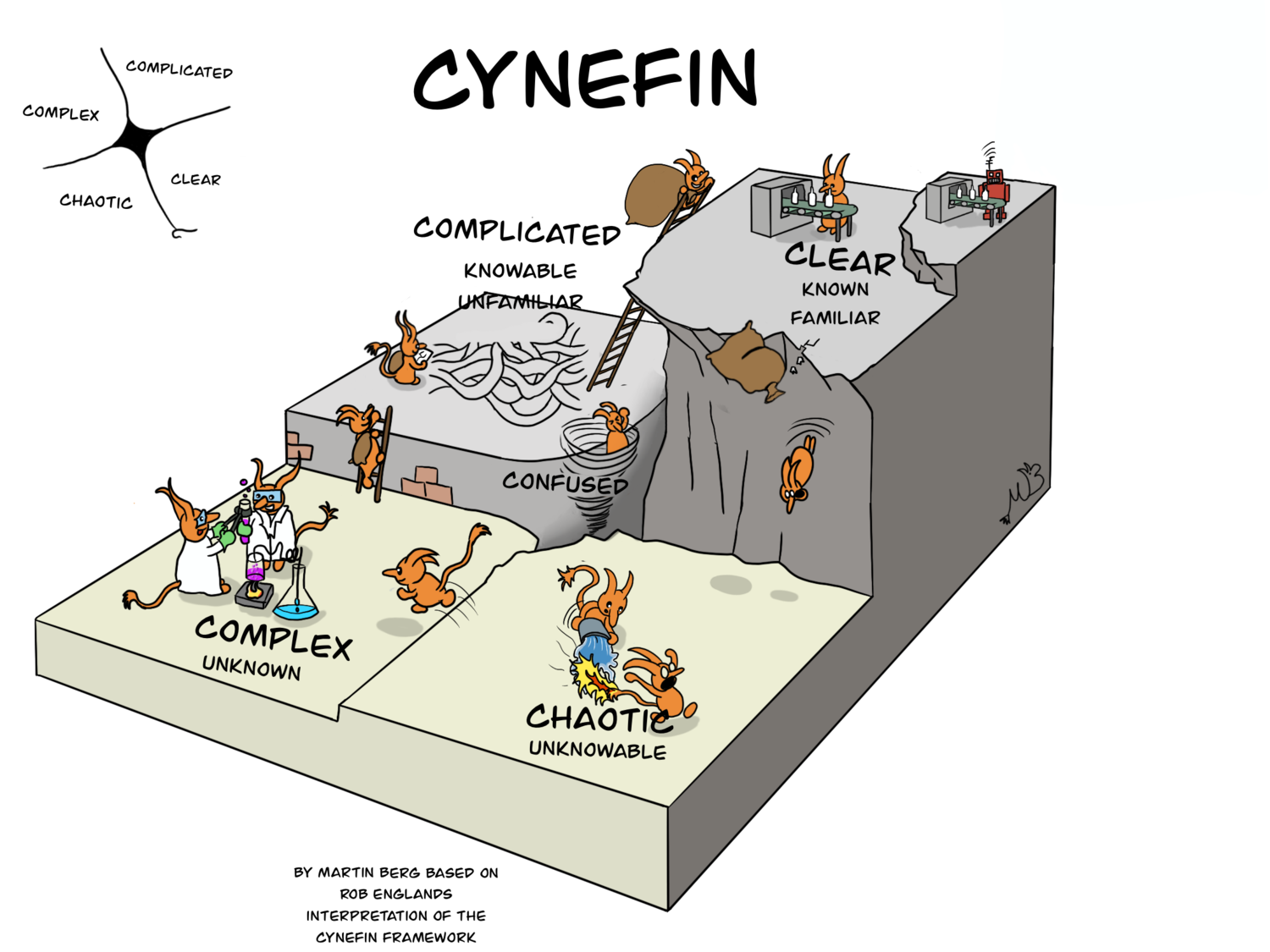
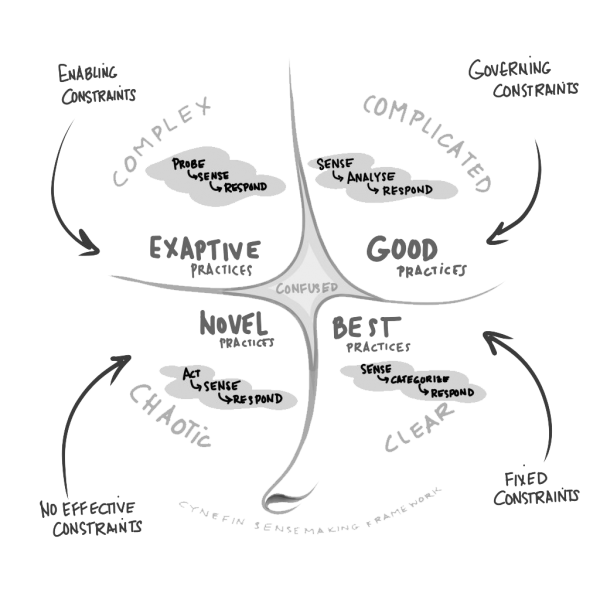
The Cynefin Framework empowers individuals and organisations to make more informed and effective decisions and distinguishes between five domains:
1. **Clear**\
In clear situations, cause and effect are obvious. Best practices and established procedures are sufficient to handle them.
2. **Complicated**\
Complicated situations, while having known causes, offer multiple possible solutions. Experts can analyse the situation and determine the optimal course of action.
3. **Complex**\
Complex situations lack clear cause-and-effect relationships. Experimentation and learning are essential to uncover underlying patterns and develop effective solutions.
4. **Chaotic**\
Chaotic situations are characterised by high uncertainty and rapid change. Immediate action is necessary to stabilise the situation and prevent further deterioration.
5. **Disorder**\
Disorder is the initial state of a situation, where its nature is unclear. Sense-making is required to categorise the situation into one of the other four domains.
#### Further Viewing
{% embed url="" %}
#### Further Reading
{% embed url="" %}
{% embed url="" %}
{% embed url="" %}
{% embed url="" %}
---
# Agent Instructions
This documentation is published with GitBook. GitBook is the documentation platform designed so that both humans and AI agents can read, navigate, and reason over technical content effectively. Learn more at gitbook.com.
## Querying This Documentation
If you need additional information that is not directly available in this page, you can query the documentation by asking a question.
Perform an HTTP GET request on the following URL with the `ask` and `goal` query parameters:
```
GET https://www.designreference.xyz/cognitive-tools/universal/decision-making/the-cynefin-framework.md?ask=&goal=
```
`ask` is the immediate question: it should be specific, self-contained, and written in natural language.
`goal` is what the user is ultimately trying to achieve, the reason they need the answer. Sharing it helps GitBook give you a better, more relevant answer. A goal is most helpful when it describes the outcome the user wants rather than restating the question. For example, with `ask=how do I create an API token`, a goal like `automate deployments from our CI pipeline` lets GitBook tailor the answer to that use case.
The response will contain a direct answer to the question and relevant excerpts and sources from the documentation.
Use this mechanism when the answer is not explicitly present in the current page, you need clarification or additional context, or you want to retrieve related documentation sections.